
If you have just opened a restaurant, or you are choosing a POS for the first time, you will hear "KOT" constantly. It is one of the simplest ideas in a restaurant, and one of the easiest to get wrong. When KOTs fail, food is late, wrong or never made.
What is a KOT?
A KOT, or kitchen order ticket, is the slip that tells the kitchen what to cook. When a server or cashier takes an order, the POS sends the food items to the kitchen as a KOT, either printed on a small thermal printer or shown on a kitchen display screen.
In some countries the same thing is called a kitchen docket, a chit or a kitchen ticket. The idea is identical: the customer's bill is for the customer, and the KOT is for the cooks. It carries only what the kitchen needs to know, in the order the kitchen needs to read it.
What is printed on a kitchen order ticket?
A good KOT carries everything a cook needs and nothing they do not. Prices are usually left off, because the kitchen does not need them.
| Field | Why it is there |
|---|---|
| Order or ticket number | So the kitchen and the floor can talk about the same order |
| Table number or order type | Dine-in table, takeaway, delivery or an app order such as Uber Eats |
| Time sent | So the kitchen can see how long an order has been waiting |
| Server or cashier name | So the kitchen knows who to ask about a query |
| Items and quantities | The core of the ticket, often in large type |
| Modifiers and notes | "No onion", "extra spicy", "sauce on the side", allergies |
| Course or station | Starters vs mains, or grill vs fryer vs bar |
The most common KOT failure is a lost modifier. If "no nuts" was entered at the counter and does not reach the cook, the system has failed at the one job it had. When you test a POS, always check how modifiers and notes appear on the ticket.
How does a KOT get from the order to the kitchen?
The KOT is created the moment the order is sent to the kitchen, and the POS decides where it goes based on what each item is.
A typical flow looks like this: the server takes the order on a terminal or handheld, presses send, and the POS splits the order by station. Grilled items go to the grill printer, fried items to the fryer, drinks to the bar. Each station gets a KOT with only its own items. Later additions to the same table go out as a new KOT marked as an addition, and cancelled items go out as a void KOT so the kitchen stops cooking them.
This routing is what separates a kitchen that runs calmly from one where the head chef is reading every ticket aloud. It is also why per-station routing is one of the first things to check in any restaurant POS.
What is the difference between a KOT and a bill?
A KOT goes to the kitchen and tells cooks what to make. A bill, or receipt, goes to the customer and tells them what to pay.
They come from the same order but serve different people. The bill shows prices, taxes, discounts and the payment method. The KOT shows items, modifiers and timing, and usually no prices at all. A restaurant can send several KOTs for one table over a meal, as more food is ordered, but the table normally gets one bill at the end, or several if it is split.
What is the difference between a KOT printer and a KDS?
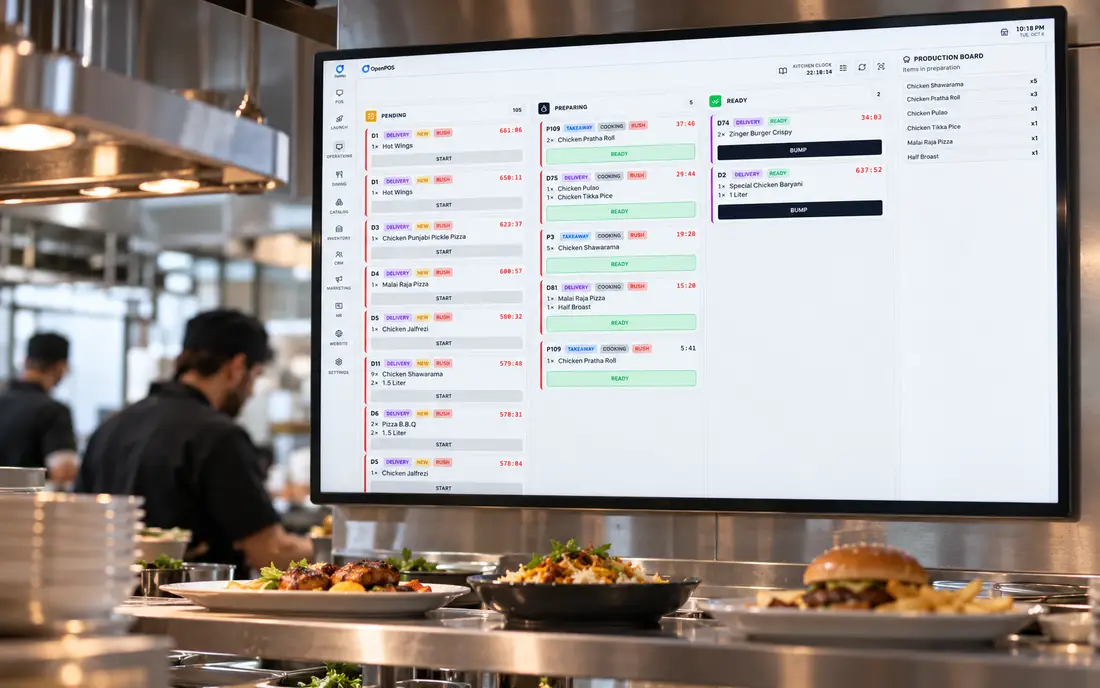
Both deliver the same kitchen order. A KOT printer puts it on paper; a kitchen display system (KDS) puts it on a screen.
Paper KOTs are cheap, familiar and hard to break, and they work well in small kitchens. A KDS adds timers, colour changes as orders age, bump buttons when an item is done, and a clear view of what is waiting. Many kitchens mix the two: a screen on the hot line and paper at the bar or for takeaway bags. Our kitchen display system guide covers the screen side in more detail.
What goes wrong with KOTs, and how do you prevent it?
Most KOT problems come from the system, not the staff. These are the usual suspects.
- Tickets that never arrive. Usually a printer offline or a POS that lost its server. An offline-first POS that routes tickets locally avoids the second cause.
- Missing modifiers. Test every modifier type in the demo, including free-text notes.
- Everything prints everywhere. Without per-station routing, every cook reads every ticket. Set routing per item or category.
- Orders typed twice. Delivery app orders retyped from a tablet. A POS that takes those orders directly prints the KOT automatically.
- No record of voids. Cancelled items should print a void KOT and be logged, so waste and mistakes are visible.
How does SureTill handle kitchen order tickets?
SureTill routes KOTs per station, to ESC/POS thermal printers connected over USB, LAN or Bluetooth, or to the kitchen display.
Dine-in, takeaway and delivery orders all produce KOTs the same way, and so do Uber Eats orders, because SureTill integrates with Uber Eats and prints those orders to the kitchen too. When the order is sent, the recipe ingredients are deducted from stock at the same moment, which keeps inventory honest.
Because SureTill runs on a server inside your restaurant, KOTs keep printing and the kitchen display keeps updating with no internet. Tickets print in Urdu, Arabic or English, which matters in kitchens where the cooks read a different language from the front of house.
Book a free 30-minute demo. We will unplug the internet mid-order and keep going. Bring your hardest questions.
Book a free demoFrequently asked
What is the full form of KOT?
KOT stands for kitchen order ticket. It is the ticket a restaurant POS sends to the kitchen, printed or on a screen, listing the items to cook with their modifiers and notes.
What is a KOT in a restaurant?
It is the instruction the kitchen cooks from. When an order is sent from the POS, each kitchen station receives a KOT with only its own items, the table or order type, the time and any special requests.
Is a KOT the same as a bill?
No. A KOT goes to the kitchen and usually shows no prices. A bill goes to the customer and shows prices, taxes and the total to pay. One table can have several KOTs but usually one bill.
What is a KOT printer?
A KOT printer is a small thermal printer in the kitchen or bar that prints kitchen order tickets. Most use the ESC/POS standard and connect to the POS over USB, a local network or Bluetooth.
Do I need a KOT printer or a kitchen display?
Either works. Paper is cheap and simple for small kitchens; a kitchen display adds timers and a clearer view of waiting orders. Many kitchens use a screen on the hot line and paper at the bar.
General guidance for restaurant owners and managers.