
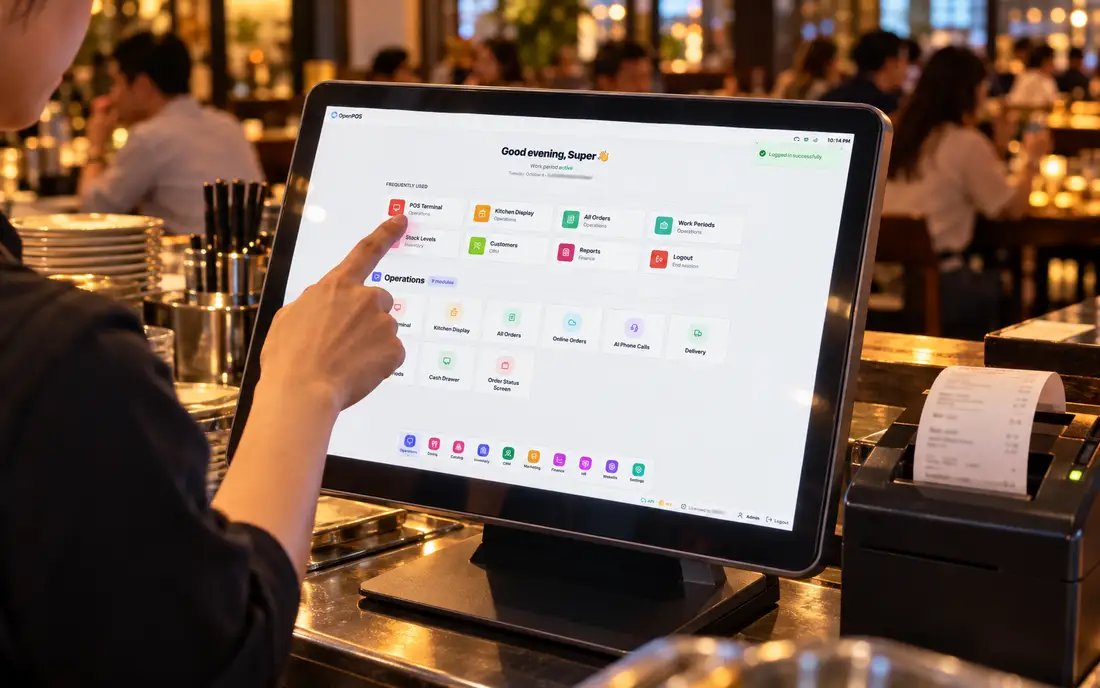
Square vs Lightspeed is one of the most common comparisons a restaurant owner makes, and most of what you will read online is either a vendor's own page or an affiliate list. We sell a different POS, so we are not neutral either. What we can do is lay out the criteria plainly, describe both products in general terms, and tell you exactly what to check yourself.
Square vs Lightspeed: which is better for restaurants?
Square tends to suit smaller cafes and quick-service venues that want card payments and the POS from one company with a low-cost start. Lightspeed tends to suit restaurants and bars that want a more configurable venue setup and a wide range of integrations, and are comfortable paying a subscription for it.
Both are mature cloud POS systems used by thousands of venues, and both change their plans regularly. Treat what follows as a framework for your own comparison, and verify current features and pricing on Square's and Lightspeed's sites before you sign anything.
How do Square and Lightspeed compare at a glance?
Here are the two side by side on the criteria that matter in a restaurant, described in general terms. The third column is what to check with each vendor, because that is where the detail lives.
| Criterion | Square for Restaurants | Lightspeed Restaurant | Verify before you buy |
|---|---|---|---|
| Company | Block, Inc. (formerly Square, Inc.) | Lightspeed Commerce; Kounta in Australia is now part of Lightspeed | Which product and plan is sold in Australia today |
| Platform | Cloud POS on iPad and Square's own hardware | Cloud POS on iPad | Supported devices and printers for your setup |
| Payments | Card processing built in, through Square | Offers its own payments in some markets; check options in Australia | Processing fees, and whether you can keep your current terminal |
| Pricing model | A free starting plan and paid tiers for more features | Subscription tiers, with add-ons for some features | Year-one and year-two total, including add-ons |
| Kitchen | Kitchen printing and a kitchen display app | Kitchen printing and kitchen display options | Per-station routing and which plan includes the KDS |
| Offline | Offline payments option for card payments, processed later | Offline mode on the iPad app | Exactly which actions keep working, on which devices |
| Delivery orders | Through integrations with delivery partners | Through its integrations marketplace | Whether orders land directly in the POS, and any extra fees |
On paper they look close. The differences show up in the detail of each row, which is why the right-hand column matters more than the other two.
How do payments and fees differ?
The biggest structural difference is payments. Square is a payments company first, so the POS and the card processing come together and you pay a processing fee on each card transaction. That makes starting simple and cheap. It also means your card fees and your POS are tied together, so moving one means moving both.
Lightspeed is primarily a software company. Depending on the market, it may offer its own payment processing, integrate with other terminals, or both. Ask which options apply to Australian venues today, and whether you can keep a terminal you already like.
Whichever you look at, ask for the total cost over two years: software, add-ons, hardware and card fees at your real monthly takings. Headline monthly prices rarely tell the whole story. Check current pricing on their sites rather than relying on any blog, including this one.
How do they handle the kitchen and delivery orders?
Both can print kitchen dockets and drive a kitchen display, and both connect to delivery apps through integrations. The questions that matter are how finely orders route and where delivery orders land.
For the kitchen, ask whether each item can route to its own station (grill, fryer, bar, cold section) and whether the kitchen display keeps updating if the internet drops. For delivery, ask whether Uber Eats and other app orders come straight into the POS and onto the kitchen docket, or whether staff still watch a tablet. Also ask whether a third-party middleware service sits in between, and what that costs. Our guide to Deliverect, Doshii and direct integrations explains that trade-off in detail.
What happens when the internet drops?
Both are cloud systems with offline modes, so the honest answer is "some things keep working, some wait". The detail decides whether your kitchen notices.
Square's offline payments option stores card payments on the device and processes them when the connection returns, within a window Square sets. If one is declined later, the seller generally carries the loss. Lightspeed's iPad app has an offline mode that keeps the device trading. With both, ask which actions keep working, whether orders still reach the kitchen and other devices, and how long the offline mode lasts. Then test it in the demo with the router unplugged.
If outages are a real worry where you trade, read does your POS need internet? first. It explains why the card terminal and the ordering system fail in different ways.
Is there an offline-first alternative to Square and Lightspeed?
Yes. If the kitchen side is your priority, an offline-first POS is worth a look alongside the two cloud names. SureTill is one.
Instead of an offline mode added to a cloud system, SureTill runs its backend and local database on a server inside your restaurant, with Windows, Linux or Android terminals. Billing, kitchen tickets per station, the kitchen display and recipe-based stock deduction keep working with no internet, then sync to a local server and an optional cloud copy. SureTill also integrates with Uber Eats through the official API, so Uber Eats orders land in the POS and print to the kitchen without a separate tablet.
Pricing is a one-time setup and training fee plus a flat monthly fee, with no cut of sales. Card payments are separate, so ask us about your payment terminal. Setup and support are remote, over WhatsApp and phone. That will not suit every venue, but for kitchen-heavy restaurants and busy takeaways it is a real alternative.
Kitchen-heavy venues often care more about dockets reaching the right station during an outage than about card payments, because most terminals can fall back to their own mobile data.
How should you decide between them?
Write down your three non-negotiables, then make each vendor demonstrate them with your own menu.
- If payments in one bundle and a low-cost start matter most, start with Square.
- If venue configuration and a wide integrations marketplace matter most, start with Lightspeed.
- If the kitchen must keep running through outages and Uber Eats orders must land without a tablet, add an offline-first option such as SureTill to the shortlist.
- Whatever you choose, get the two-year total cost in writing and test with the internet unplugged.
Book a free 30-minute demo. We will unplug the internet mid-order and keep going. Bring your hardest questions.
Book a free demoFrequently asked
Is Square or Lightspeed better for a restaurant?
Square tends to suit smaller cafes and quick-service venues that want payments and POS in one bundle. Lightspeed tends to suit restaurants and bars that want more configuration and integrations. Check current features and pricing on both sites before deciding.
Is Kounta the same as Lightspeed?
Kounta was an Australian POS that became part of Lightspeed, so Australian venues that used Kounta are now on Lightspeed's products. Check with Lightspeed for the current plan names.
Do Square and Lightspeed work offline?
Both offer offline modes. Square has an offline payments option that processes stored card payments later, and Lightspeed's iPad app has an offline mode. Ask each vendor exactly which actions keep working and test it with the internet unplugged.
Can I keep my own card terminal?
With Square, card processing is built into the system. With Lightspeed, options depend on the market, so ask which terminals are supported in Australia. With SureTill, ask us about your payment terminal.
What is an alternative to Square and Lightspeed for restaurants?
SureTill is an offline-first restaurant POS for Windows, Linux and Android. It keeps billing, kitchen tickets, the kitchen display and stock running with no internet, and it integrates with Uber Eats through the official API.
Competitor information is general and based on publicly available information at the time of writing. Features, plans and pricing change, so verify current details on Square's and Lightspeed's sites. Square is a trademark of Block, Inc.; Lightspeed is a trademark of Lightspeed Commerce Inc. SureTill is not affiliated with either.